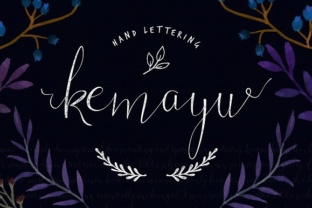
Kemayu Script Handwritten Font for Makers
It was 10 p.m., candle wax still smudged on my desk, and I was tweaking the final label for a new lavender-vanilla soy candle—my third round of mockups that week. The client wanted “elegant but warm,” “handmade but polished,” and “instantly recognizable as *mine*.” I opened Kemayu, typed “Wild Bloom Candle Co.” in all caps, and watched the letters flow like ink pulled gently across watercolor paper. That’s when it clicked: Kemayu is a elegant, hand lettering typeface—not stiff or overly ornate, not cartoonish or rushed—but *alive*, with subtle pressure shifts, graceful entry/exit strokes, and a quiet confidence that says “I was made by hand, just like you.”
Kemayu for Wedding Invitations and Elegant Branding
Kemayu shines brightest where intention meets intimacy—like wedding stationery. I tested it on a digital invitation suite: “Alex & Sam Invite You” as the headline, paired with a clean sans serif (Montserrat Light) for details. The contrast worked beautifully—Kemayu carried the emotional weight, while the supporting font handled logistics without competing. Its Script Handwritten rhythm gives names and dates a personal, almost whispered reverence. On printed vellum, the slight texture of the letterforms softened under soft lighting—no harsh edges, no robotic uniformity. For boutique wedding brands, this isn’t just a font—it’s a tone-of-voice tool. It signals care, curation, and craft. Just remember: use Kemayu for headlines, names, and short phrases only. Avoid body text—its charm lies in display use, not dense paragraphs.
Kemayu for Candle Labels, Product Tags, and Boutique Packaging
I printed Kemayu on kraft sticker paper for mini candle labels (1.5″ x 2″), then ran them through my Cricut Maker. The script held up surprisingly well—even at small sizes, the key letterforms (like the looping “y” and open “a”) remained legible. That said, I wouldn’t go smaller than 14 pt for cut vinyl or intricate die-cut tags. What makes Kemayu ideal for handmade product labels is its balance: it feels artisanal but not fussy, fun but never childish. Paired with a simple serif (like Playfair Display Regular) for scent notes or ingredients, it creates instant hierarchy and warmth. As Fonts go, Kemayu supports commercial licensing—so yes, you can embed it in your Etsy listing PDFs, use it on physical packaging, and even include it in editable Canva templates (as long as your license permits). Always double-check the included file formats (.OTF/.TTF) and whether swashes or alternates are bundled—they add polish to premium packaging.
Kemayu for Printable Wall Art and Digital Downloads
For printable creators, Kemayu is a quiet powerhouse. I designed a set of minimalist botanical wall quotes (“Breathe Deeply,” “Grow Wild,” “Tend Your Light”) using Kemayu as the sole typographic element—no illustrations, no borders—just centered lines on soft ivory paper. The result? Instant visual calm. Because Kemayu is a elegant, hand lettering typeface, it adds humanity to digital files that might otherwise feel sterile. On screen, it renders cleanly in both web browsers and PDF viewers. For social media previews, it scales gracefully from Instagram carousels to Pinterest pins. Bonus: since it’s a Script Handwritten font with natural stroke variation, it avoids the “too-perfect” look that can dilute perceived authenticity in digital printables. Just avoid pairing it with other decorative scripts—let Kemayu breathe alongside neutral, grounded fonts like Lora or Inter.
Kemayu for Tote Bags, Mugs, and Merchandise Design
I mocked up a linen tote bag with “Good Things Grow Here” in Kemayu, then checked how it translated to print-on-demand previews. The script’s moderate contrast and open counters kept it readable at 2.5″ height—even on textured fabric. Same for ceramic mugs: the gentle curves softened the rigidity of the surface, making slogans feel inviting rather than loud. That’s the magic of this Script Handwritten font—it doesn’t shout; it leans in. For merchandise, Kemayu works best for short, evocative phrases—not brand names with complex spelling or technical terms. And always test your file output: some POD platforms compress vector paths, so export as outlined text or high-res PNG if needed. As Fonts go, Kemayu includes standard Latin characters and basic punctuation—perfect for English-language makers, though multilingual support is limited (no extended diacritics or Cyrillic).
Kemayu for Greeting Cards and Seasonal Sticker Sheets
Last holiday season, I built a sticker sheet of tiny sentiments—“Joy,” “Snow,” “Cozy,” “Merry”—all in Kemayu. At 10–12 pt, the script stayed charming and distinct, especially when layered over watercolor backgrounds. For greeting cards, I used Kemayu for the front sentiment only, then switched to a light-weight sans serif inside. Why? Because Kemayu is a elegant, hand lettering typeface built for impact, not endurance. Its personality is strongest when given space—and when contrasted with something simpler. If you’re cutting stickers with Silhouette or Cricut, turn on “cutting preview” to check for thin joins (like the crossbar in “t” or tight loops in “e”). Most cuts came out clean, though I avoided ultra-fine outlines on delicate paper stocks.