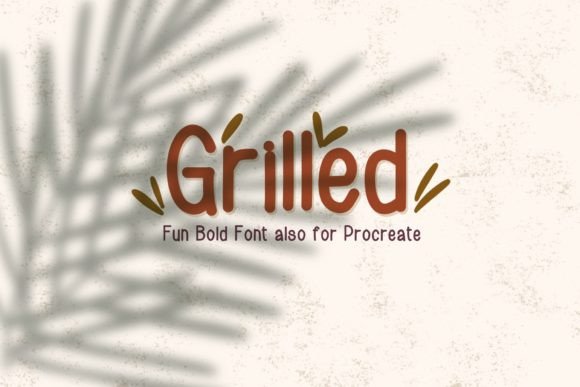
Grilled: A Clean Script Handwritten Font for Modern Websites
I was finalizing the hero section of a boutique online store’s homepage—soft photography, minimalist layout, warm neutral palette—when the headline font felt off. Not wrong, exactly, but too rigid. Too distant. So I swapped in Grilled, and instantly, the tone shifted: warmer, human, intentional. That’s the quiet power of Grilled: a Script Handwritten typeface that feels personal without sacrificing polish. It’s not scribbled or overly ornate—it’s clean, legible, and deeply web-aware.
Grilled for Hero Sections and Landing Page Headlines
On a product landing page for a small-batch ceramic studio, I used Grilled for the main headline (“Hand-thrown, Slow-made”) over a full-width image banner. At 48px on desktop and 36px on mobile, it held clarity without blur or pixelation—even with light tracking and subtle letter spacing. Because Grilled is a Script Handwritten font designed with digital contrast in mind, it avoids the common trap of fading into background textures or losing shape at smaller sizes. No faux-bold tricks needed. Just clean, confident presence.
Grilled for Coaching Website Headers and Brand Voice Alignment
A life coach’s website needed warmth without cliché—no cursive swirls, no forced whimsy. Grilled delivered exactly that: a Script Handwritten rhythm that feels grounded and sincere. I paired it with Inter (a neutral, highly readable sans serif) for body copy and navigation. The contrast worked beautifully: Grilled carried voice and personality in headings and testimonials; Inter handled information, structure, and scanning. This pairing reinforced trust—not by shouting “creative!” but by balancing authenticity with professionalism. As a Fonts choice, Grilled doesn’t dominate. It invites.
Grilled for Digital Brand Kits and Consistent Web Typography
When building a digital brand kit for a freelance illustrator’s portfolio site, consistency across formats mattered—website, social banners, email headers, downloadable PDFs. Grilled scaled cleanly from 24px Instagram story text to 60px homepage titles. Its even stroke weight and open counters kept readability high on both light and dark UI backgrounds. Crucially, the Script Handwritten style didn’t sacrifice versatility: it worked as logo text (in SVG), as a decorative accent in section dividers, and as a subtle typographic motif in hover states. As a commercial Fonts asset, its licensing covers all these uses—no surprises when exporting Figma files or deploying live.
Grilled for Online Shop Banners and Product Storytelling
In an e-commerce redesign for a sustainable skincare line, I tested Grilled on product category banners (“Vitamin C Serum”, “Overnight Mask”). Short phrases only—but powerful ones. Here, Grilled’s clean design shone: no competing flourishes, no uneven baseline wobble, just gentle movement and quiet confidence. On mobile, I reduced size to 28px and increased line-height slightly—still fully legible, still unmistakably human. Unlike many Script Handwritten fonts that collapse at smaller sizes, Grilled maintains character without compromising scannability. That matters when shoppers glance, scroll, and decide in under three seconds.
Grilled for Course Sales Pages and Trust-Building Headlines
A course creator launching a workshop on mindful productivity needed typography that reflected calm intention—not urgency or hype. Grilled became the headline font for key sections: “Start Your Calm Workflow”, “What You’ll Build”, “Join 420+ Learners”. Paired with a lightweight serif (like Literata) for subheads and body text, Grilled added warmth while keeping hierarchy clear. As a Fonts choice, it signaled care—not just in content, but in presentation. No extra plugins, no variable font complexity: just one clean Script Handwritten file, well-hinted, fast-loading, and supported across modern browsers.
Grilled for Blog Headers and Editorial Digital Identity
For a redesigned blog about slow living and analog creativity, Grilled anchored each post header—centered, modestly sized, often with generous whitespace. Its clean design meant it never overwhelmed delicate photography or muted color palettes. And because Grilled is a Script Handwritten typeface built for screen use, it rendered crisply even in Safari’s sometimes finicky text rendering. I avoided using it for pull quotes or long paragraphs (that’s where a strong sans serif shines), but for blog titles? Perfect. Human, unhurried, and unmistakably intentional.
Grilled for Responsive Buttons and Micro-Interactions
Yes—Grilled works in buttons, too. Not for primary CTAs like “Buy Now” (where clarity trumps flair), but for secondary actions: “Learn More”, “See the Process”, “Read the Story”. At 16px with tight letter-spacing and ample padding, it added subtle personality without hurting tap targets or accessibility. Tested on iOS and Android, it remained crisp and legible—even with dynamic type scaling enabled. As a Fonts option, Grilled includes well-designed punctuation and numerals, so dates, prices, and version numbers stay cohesive.
Grilled Font Pairing Strategies for Web Designers
Pairing Grilled thoughtfully unlocks its full potential. My go-to combos:
- Grilled + Inter or Manrope — for clean, accessible, performance-optimized sites (ideal for SaaS dashboards, coaching sites, portfolios)
- Grilled + Literata or PT Serif — for editorial depth and narrative flow (blog headers, course sales pages, storytelling campaigns)
- Grilled + a monospace (like Recursive) — for creative contrast in tech-adjacent brands or developer-focused content
All work because Grilled is a Script Handwritten font with restrained energy—not chaotic, not cold. It breathes alongside supporting type, never competes.
Grilled Font Licensing and Web Deployment Notes
Before dropping Grilled into a client project or live site, I always check: Is it licensed for web use? Does it include WOFF2? Are there stylistic alternates or ligatures included? For Grilled, the answer is yes across the board—commercial license, webfont-ready formats, clean OpenType features, and no hidden restrictions. That means you can confidently use it in Figma prototypes, Webflow projects, Shopify themes, WordPress sites, and Notion-based brand guidelines. As a Fonts investment, it’s lightweight, versatile, and built for real-world digital workflows—not just mockups.